Friday, January 28, 2011

Learning, plasticity and evolution

!!!!!!!! New time for lab meetings this semester will be 13:30!!!!!!!!!!!!!!

Erik and I have been talking about how to measure and conceptualize the effects of learning on evolution. All in the light of our learning in our ongoing Calopteryx learned mate preference project of course.
To this effect, I've chosen two papers that are on this topic.
The first is an interesting paper by Ingo Paenke and Tadeusz Kawecki in Am Nat that models an old concept: the Baldwin effect: namely that plasticity (which, s.l. includes learning) can both accelerate and impede evolution. It explores if and when learned behavior may exert directional selection. You can download it here, the abstract is pasted below.

The second is a recent TREE paper by David Pfennig et al (download it here) that discusses the effect of phenotypic plasticity on diversification and speciation. Although they don't mention specifically to include learning, I of course will read it in that light, but then, I may be a little biased ;). Again, abstract is pasted below.
Hope you'll enjoy it too!


Phenotypic plasticity’s impacts on diversification and speciation

David W. Pfennig, Matthew A. Wund, Emilie C. Snell-Rood, Tami Cruickshank, Carl D. Schlichting and Armin P. Moczek


Phenotypic plasticity (the ability of a single genotype to produce multiple phenotypes in response to variation in the environment) is commonplace. Yet its evolutionary significance remains controversial, especially in regard to whether and how it impacts diversification and spe- ciation. Here, we review recent theory on how plasticity promotes: (i) the origin of novel phenotypes, (ii) diver- gence among populations and species, (iii) the formation of new species and (iv) adaptive radiation. We also discuss the latest empirical support for each of these evolutionary pathways to diversification and identify potentially profitable areas for future research. Gener- ally, phenotypic plasticity can play a largely underappre- ciated role in driving diversification and speciation.


Influence of Plasticity and Learning on Evolution under Directional Selection

Ingo Paenke, Bernhard Sendhoff, and Tadeusz J. Kawecki


Abstract:

Phenotypic plasticity and related processes (learning, developmental noise) have been proposed to both accelerate and slow down genetically based evolutionary change. While both views have been supported by various mathematical models and simulations, no general predictions have been offered as to when these alternative outcomes should occur. Here we propose a general framework to study the effects of plasticity on the rate of evolution under directional selection. It is formulated in terms of the fitness gain gradient, which measures the effect of a marginal change in the degree of plasticity on the slope of the relationship between the genotypic value of the focal trait and log fitness. If the gain gradient has the same sign as the direction of selection, an increase in plasticity will magnify the response to selection; if the two signs are opposite, greater plasticity will lead to slower response. We use this general result to derive conditions for the acceleration/deceleration under several simple forms of plasticity, including developmental noise. We also show that our approach explains the results of several specific models from the literature and thus provides a unifying framework

Sunday, January 23, 2011

Lab-meeting on insect wing colouration and UV-vision


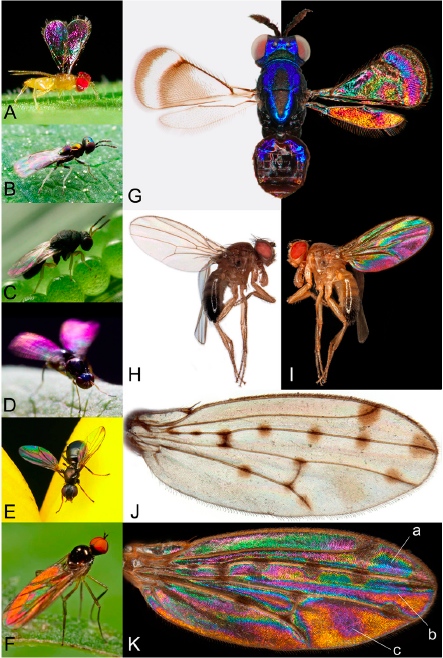
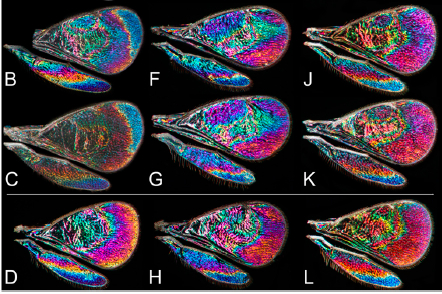
At the first lab-meeting of 2011 (January 26, at 10.15 in "Darwin"), I was thinking that we should discuss two new interesting papers about insect wing colouration and insect UV-vision. The first one is the beautiful paper in PNAS by some systematist colleagues from our own department in Lund (see pictures above), and the second one is about sexual selection and UV-vision in butterflies by Ron Rutowski's group. The two papers are partly related, and should be read as companions. They have some relevance to our past and ongoing work on wing colouration in damselflies, including the UV spectrum (as yet unpublished, but in preparation by Maren, Mikkel and myself). These two papers can be downloaded here and here.

The Morehouse/Rutowski-study deals with female choice of male wing colouration of white cabbage butterflies. It deals with vision in the UV-spectrum, and how male attractiveness and predation risk are linked to each other, when explicitly modelling the UV-vision properties of mates and predators. It has also been covered by the popular science site Science Shot. It is highly relevant to our own work on damselflies, I think. Incidentally, Ron Rutowski will be external opponent on a thesis on butterfly ecology in Stockholm on March 18, 2011, where I am in the committée and there will be a small symposium the day before where Mactheld and I will give research presentations, so we can ask him then about details this study if some questions come up during our lab-meeting on Wednesday.

The "Lund paper" in PNAS is about iridescent colouration on transparent insect wings ("Wing Interference Patterns", or WIP:s), how such WIP:s can be used as species and sex-identification cues and the implications for systematics and evolutionary developmental biology ("evo devo"). It might very well turn out that this paper will revolutionize and speed up the process of species identification in some difficult groups such as small hymenopterans and dipterids. If the paper holds what it promises, it might even be more useful than DNA-based species-identification methods, as it is faster, cheaper and non-invasive, making the method of much practical use when working with museum collections of small animals where one could not (or do not want) to sacrifice tissue, but need to identify species anyway. Obviously, the paper have implications also for speciation, species recognition and sexual selection.

There are two detailed and interesting blog posts about this paper by evolutionary geneticist Jerry Coyne on "Why Evolution is True" and by Ed Young at "Not Exactly Rocket Science". Both are worth reading, in addition to the original paper. Ed Young points out another interesting implication of this study: "Since the colours come from the microscopic shape of the wing, every hair, bump, ridge and vein affects the pattern of the WIPs. If an insect evolves a larger, thicker wing, its colours change. If the wing gains or loses veins, the colours change. Indeed, the unseen influence of these colours could explain why the veins of some insect wings are incredibly varied, for no obvious reason. Through these changing colours, the evolution of flies and wasps may start becoming more transparent." 

 As we have often discussed the adaptive significance of various small morphological aspects of insect wings (e. g. shape, the number of positions of veins etc.) in our own work in our lab, this adds another interesting dimension to such structures, although it should be said that these WIP:s are only known to operate on small wings (1 cm or less) and are unlikely to be important in larger insects like odonates, unfortunately.


I hope you will enjoy these two interesting papers, as well as appreciate the links above. Time and place as usual for our lab-meeting: Wednesday (January 26) at 10.15 in "Darwin". Any fika volunteer?

Saturday, January 22, 2011

Dr. Yuma Takahashi receives postdoctoral scholarship from Japan to join our lab


I am pleased to announce that Dr. Yuma Takahashi from Japan has been awarded a three-year postdoctoral scholarship, and will join our laboratory in 2012. Yuma received his doctorate degree at University of Tsukuba and in his thesis work he studied female colour polymorphism, frequency-dependent selection and evolutionary dynamics of the damselfly Ischnura senegalensis. You can read more about Yuma's research here. His study organism (I. senegalenis) is a small coenagrionid damselfly is closely related to Ischnura elegans, which we have studied in our lab.

There are many interesting similarities, but also difference between these two polymorphic species. One major difference, though, is that Ischnura senegalensis has only two female morphs, not three as in Ischnura elegans. Another interesting ecological difference is that the male mimicking androchrome females are often in minority in I. senegalensis, or at least not much more than 50 % of the female population, whereas this female morph is often the most common morph in I. elegans (at least in Sweden where we have mainly studied it). These interesting ecological species differences will hopefully be understood better and be explored after Yuma joins our lab in 2012.

Yuma has already published eight papers from his thesis-work and here I would just like to point to his latest one, which recently appeared in the journal Evolution. Using a powerful combination of field observations and experiments and simulation modelling, they elegantly illustrated the evolutionary dynamics of this polymorphic system which strongly suggest that this dynamic is most likely the result of frequency-dependent sexual conflict interactions, caused by male-female antagonistic mating interactions. In short: males develop a "search image" for common female morphs, and common morphs become differentially sexually harassed, resulting in an inverse relationship between a morph's fitness and its frequency in the population, which leads to negative frequency-dependent selection (NFDS), a very powerful evolutionary mechanism to maintain genetic polymorphisms. 

These findings and conclusions by Yuma and his co-workers are very similar to our paper on I. elegans that we published in 2005 in American Naturalist. It is of course nice to see that the genus Ischnura continues to generate interesting studies and inspire evolutionary biologists in different countries, including Japan. As an aside, the next international dragonfly conferences (WDA) will also take place in Japan, south of Tokyo between July 31 and August 5 2011. I am very happy and flattered to become invited as a plenary speaker to this rather small meeting of odonate enthusiasts, amateurs, naturalists and researchers.

Below is the Abstract and link to Yuma's article in Evolution, for those who are interested in reading more about this fascinating species and study system:


Takahashi, Yuma, Yoshimura, Jin), Morita, Satoru) & Watanabe, Mamoru


Abstract: Negative frequency-dependent selection (NFDS) is one of the most powerful selective forces maintaining genetic polymorphisms in nature. Recently many prospective cases of polymorphisms by NFDS have been reported. Some of them are very complicated, although strongly supportive of the NFDS. Here we investigate NFDS in wild populations of the dimorphic damselfly Ischnura senegalensis, in which females occur as andromorphs and gynomorphs. Specifically, we (1) test fitness responses to morph frequencies, (2) built a simple population genetic model, and (3) compare the observed and predicted morph-frequency dynamics. Fitnesses of the two morphs are an inverse function of its own frequency in a population, and are about equal when their frequencies are similar. Thus the conditions necessary for NFDS are satisfied. The long-term field surveys show that the morph frequencies oscillate with a period of two generations. Morph frequencies in a small population undergo large oscillations whereas those in a large population do small oscillations. The demographic properties of the observed dynamics agree well with those of our model. This example is one of the simplest confirmed cases of NFDS maintaining genetic polymorphisms in nature.

Tuesday, December 28, 2010

Happy New Year!


I hereby wish all my co-workers (students, PhD-students, postdocs and colleagues) a Happy New Year 2011! I certainly hope that the new year will be as succesful as the previous was, for many of us. Apart from several good publications in excellent journals (BMC Evolutionary Biology, Evolution, J. Evol. Biol., TREE to mention only a few) I would also like to highlight some other great highlights (to me personally):

1. Kristina Karlsson succesfully defended her PhD in November and have already published most of her thesis-papers. Well done!

2. Fabrice Eroukhmanoff got a postdoctoral 2-year grant from The Swedish Research Council (VR) to go to Norway (Oslo University) and work with Glenn-Pether Saethre and Thomas F. Hansen.

3. Machteld Verzijden found out, just before Christmas, that she will stay in our lab for 2-3 more years, due a postdoctoral scholarship from the Wenner-Gren Foundations.

4. Former postdoc Shawn Kuchta got a faculty position at Ohio University (Athens, USA), and started up his new lab from the beginning of September 2010. Sophia Engel visited him during November, and I will myself go there for a visit in April 2011.

Needless to say: I am proud to work with such a group of excellent and dedicated scientists as you guys! Although academic life is stressful and we compete (like all other groups) for grants and to get our papers published in good journals, I think we are doing remarkably well, as a lab and as a group. I think this is because we regularly meet and discuss science - in a friendly and cooperative atmosphere. This is the key to sucess - much more than large research grants. I hope we can continue along this succesful path for many years to come.

As for myself, I will now leave for South Africa (well, tomorrow!), and will be back in the last week of January. Until then; enjoy this picture of a Greater Collared Sunbird, photographed in the Eastern Cape Province in South Africa in April this year. My overly ambitious daughter My (who is soon a professional blogger and expert in HTML-programming, by the way), has started up a new photo blog, where she wants us both to upload our photos during the trip to South Africa. You can find it here.

I am not sure I will allocate that much time as my daughter expects me to, as I want to stay away from the internet for a while, when enjoying field work, good wine, birds and wildlife. But keep following this other blog, perhaps I will change my mind :).

Sunday, December 19, 2010

How we are evolving and more on the "missing heritability" problem


Although I suggested  we should skip articles for next lab-meeting (Wednesday 22 December), I changed my mind after finding a couple of interesting papers in the popular science magazine Scientific American. Both deal with human evolution and human genetics, and should be an easy read, and are of much principal interest, also to us.

The first one raises the question "How we are evolving" and it discusses the recent recent data obtained from "Next-generation sequencing" that have elucidated the evolutionary history of coding genes in Homo sapiens. It turns out that so-called "selective sweeps" are quite unusual in our genome, i. e. alleles that have quickly increased in frequency in response to local selection pressures and in local environments. Thus, the case of the recent demonstrated selective sweep in the genes affecting haemoglobin production when humans invaded the Tibetan Plateau that we discussed earlier this year, are atypical, and do not seem to be the norm (according to the article in Scientific American).

Instead, it appears that the global distribution of human coding genes more reflects recent migration histories: genes that increased in frequency at a certain place were then carried along to new places as human colonized the Earth. This implies that selective sweeps are rare, and they mainly happen when there is strong and sustained selection that is consistent over relatively long time at a given place. This implies that selection might in general be relative weak, in humans at least. Perhaps humans are able to adapt (culturally) and counteract selection pressures by cultural adaptations, such as clothing, food habits etc., which weakens natural selection in many environments?

The other article in Scientific American deals with the so-called "missing heritability"-problem, i. e. the uncomfortable facts that there are very few genes explaining a substantial amount of variation in diseases. Thus, most large-effect genes are quite rare in the populations, whereas those genes that are common explain only a tiny fraction (in the order of a few percent) of the disease-related variation. This has caused despair among molecular biologists and biomedical researchers, since the huge amount of sequencing data has not solved many of Homo sapiens biomedical problems (contrary to promises in the most enthusiastic heydays of genome sequencing). In spite of thousands of variable SNP:s ("single-nucleotide polymorphisms"), only a few percent of the total amount of variation in human phenotypic traits are explained by these molecular markers. This can either be interpreted as a great disappointment (in relation to promises), a complete failure for molecular biology or a great triumph of quantitative genetics, but as usual, the questions that are raised by these findings might be more interesting than the exact answers. The solution? Well, certainly not to sequence more or try to obtain more SNP:s, but rather to think harder (surprisingly, an underutilized strategy in much of today's science!).

The two articles can be found here and here, and I think you will enjoy both, as they are relatively easy read. Let's have a brief and informal discussion about these papers on Wednesday, after we've had some glögg!

Friday, December 17, 2010

Soon Christmas and last lab-meeting for this year on December 22 2010


Wednesday 22 will be the last lab-meeting for this year before Christmas, and before I leave for South Africa. I was thinking we should skip a paper this time, and just discuss some general issues and any remaining practicalities before the winter break. I will bring "glögg" (both with and without alcohol!), if somebody else could volunteer to bring "lussekatter" and/or pepparkakor.

Hope to see you in "Darwin" then on December 22. Same time as usual: 10.15.

Interesting blog about "Eco-evolutionary dynamics" by Andrew Hendry's lab

Those of you have met Andrew Hendry before, either in Vienna during the "Speciation"-meeting last week, or last year when he was the external opponent on the PhD-thesis by Fabrice Eroukhmanoff, might enjoy this blog from his research laboratory. His lab seem to have a similar attitude as ours when it comes to public outreach and using social media, which is nice. A general theme of their blog is "Eco-evolutionary dynamics", which fits well with the kind of research Hendry et al. have been pursuing in recent years, using sticklebacks, guppies and Galápagos finches as study organisms. Enjoy!