Sunday, February 16, 2014

Personality and politics


Posted by Jessica Abbott on behalf of Utku Urhan

Swedish elections are approaching, therefore paper i picked for next week's lab meeting is somewhat related to this event. I assume there is nothing wrong with discussing politics within the context of genetics and evolution.

Kandler et. al's study is a good example of how genes may have control over our decisions and perspective on life. Kandler et. al defines left and right ideology according to attitude towards equality and system change. They analyze genetic and environmental factors and their interactions which may cause attitude differences towards these two key concepts. They also take important factors, such as assortative mating and main personality traits, into account.

Left or Right? Sources of Political Orientation: The Roles of Genetic Factors, Cultural Transmission, Assortative Mating, and Personality Christian Kandler, Wiebke Bleidorn, and Rainer Riemann
In this study, we used an extended twin family design to investigate the influences of genetic and cultural transmission as well as different sources of nonrandom mating on 2 core aspects of political orientation: acceptance of inequality and rejecting system change. In addition, we studied the sources of phenotypic links between Big Five personality traits and political beliefs using self- and other reports. Data of 1,992 individuals (224 monozygotic and 166 dizygotic twin pairs, 92 unmatched twins, 530 spouses of twins, 268 fathers, and 322 mothers) were analyzed. Genetically informative analyses showed that political attitudes are genetically but not environmentally transmitted from parents to offspring and that a substantial proportion of this genetic variance can be accounted for by genetic variance in personality traits. Beyond genetic effects and genotypic assortative mating, generation-specific environmental sources act to increase twins’ and spouses’ resemblance in political beliefs. The results suggest multiple sources of political orientations in a modern democracy.

http://www.researchgate.net/publication/51711289_Left_or_right_Sources_of_political_orientation_the_roles_of_genetic_factors_cultural_transmission_assortative_mating_and_personality/file/9fcfd50b7cb070c264.pdf

Friday, February 7, 2014

Do good looks mean you're more fit?


Posted by Jessica Abbott on behalf of Qinyang Li
File:TourDeFrance 2005 07 09.jpg

Hello everyone, next lab meeting I suggest we can discuss the studies and evolutionary theories about human facial attractiveness and their physical performance. There are some papers published on this topic, but we will focus on the most recent one. In this study, elite male cyclists were chosen as test subject since endurance is a strong predictor of fitness. The ratings on their attractiveness turned out to be positively correlated with their performance.

Abstract:
Females often prefer to mate with high quality males, and one aspect of quality is physical performance. Although a preference for physically fitter males is therefore predicted, the relationship between attractiveness and performance has rarely been quantified. Here, I test for such a relationship in humans and ask whether variation in (endurance) performance is associated with variation in facial attractiveness within elite professional cyclists that finished the 2012 Tour de France. I show that riders that performed better were more attractive, and that this preference was strongest in women not using a hormonal contraceptive. Thereby, I show that, within this preselected but relatively homogeneous sample of the male population, facial attractiveness signals endurance performance. Provided that there is a relationship between performance-mediated attractiveness and reproductive success, this suggests that human endurance capacity has been subject to sexual selection in our evolutionary past.

Link: 


Thursday, February 6, 2014

Bowling competition between Animal Flight Lab and EXEB: "It's complicated, dude"


Posted by Erik Svensson


The bowling competition between our research colleagues at the Animal Flight Lab and EXEB that took place recently was a success, although I personally felt that Professor Anders Hedenström showed worrying signs of stereotypic behaviour (watch video above!). Perhaps he was to focussed on trying to win?

The outcome of the competition of the labs has not yet been analyzed - there are problems with the data which precludes the decision of the winner. Nevertheless, it was a very nice evening, and we all tried our best to achieve the skills of Jesus, Walter and "The Dude" - with varying success (see video below):


Afterwards, our two labs went to "Berliner Bar" for some well-deserved beers and classic German-style food. It was a great evening, and our labs have so much in common, and our scientific skills largely complement each other. EXEB:s focus on population biology, ecological and evolutionary genetics could certainly mix well with evolutionary biomechanics and flight morphology, given that both labs now are very focussed on insects. Hopefully we can repeat this succesful event, and perhaps go to some other nice place in the future? Time will tell.

Below are some more pictures from this nice event. Enjoy!


Thursday, January 30, 2014

Labmeeting on niches and sexual communication in antbirds

Phenotypic divergence and evolutionary age in co-occurring lineages.

Phenotype in relation to habitat and evolutionary history.

Posted by Erik Svensson

The next weeks lab-meeting we will discuss some classical problems in ecology and evolution namely niche evolution, reproductive character displacement (or the lack thereof) and sexual communication. I have chosen a recent article on a South American bird radiation in Nature, co-authored by our Lund colleague Charlie Cornwallis and another paper on the same topic in PNAS by the same Oxford group (Joseph A. Tobias and Nathalie Seddon).

The titles and Abstracts of both these papers are found below, where you can also find link to these papers. Charlie has promised that he will be present to answer any more specific questions we might have on the results, the analyses and other background information about this fascinating system.

When: Tuesday February 4 at 10.30
Where: "Argumentet", 2nd floor (Ecology Building)

Species coexistence and the dynamics of phenotypic evolution in adaptive radiation 

Joseph A. Tobias, Charlie K. Cornwallis, Elizabeth P. Derryberry, Santiago Claramunt, Robb T. Brumfield & Nathalie Seddon

Nature doi:10.1038/nature12874

Interactions between species can promote evolutionary divergence of ecological traits and social signals, a process widely assumed to generate species differences in adaptive radiation. However, an alternative view is that lineages typically interact when relatively old, by which time selection for divergence is weak and potentially exceeded by convergent selection acting on traits mediating interspecific competition. Few studies have tested these contrasting predictions across large radiations, or by controlling for evolutionary time. Thus the role of species interactions in driving broad-scale patterns of trait divergence is unclear. Here we use phylogenetic estimates of divergence times to show that increased trait differences among coexisting lineages of ovenbirds (Furnariidae) are explained by their greater evolutionary age in relation to non-interacting lineages, and that—when these temporal biases are accounted for—the only significant effect of coexistence is convergence in a social signal (song). Our results conflict with the conventional view that coexistence promotes trait divergence among co-occurring organisms at macroevolutionary scales, and instead provide evidence that species interactions can drive phenotypic convergence across entire radiations, a pattern generally concealed by biases in age.


Species interactions and the structure of complex communication networks


Friday, January 24, 2014

Lab Meeting about Research Careers and Reputation

Posted by Anna Nordén

Hello everyone,
For the next meeting, I thought we could discuss research careers and reputation in science. The first short article is about how to build and maintain a scientific reputation with ten simple rules. The other one is a quantitative study about the difference between PhD students’ preferences for making a career in either academia or industry. I thought we could focus on their findings, that PhD students staying in academia have a stronger ‘taste for science’. 
Do you agree with the ten simple rules or are there more ‘rules’ that should have been included? What does it actually mean to have a stronger or weaker ‘taste for science’?

Tuesday 28/1 at 10:30 – 12 in Argumentet as usual and I will provide fika.

I’m looking forward to hear about your experiences and opinions on this topic!

By Philip E. Bourne, Virginia Barbour

By Michael Roacha, Henry Sauermann


Abstract
Recent research on industrial and academic science draws on the notion that academically trained scientists have a strong “taste for science”. However, little attention has been paid to potential heterogeneity in researchers’ taste for science and to potential selection effects into careers in industry versus academia. Using survey data from over 400 science and engineering PhD students, we examine the extent to which PhD students’ taste for science (e.g., desire for independence, publishing, peer recognition, and interest in basic research) and other individual characteristics predict preferences for research careers in industry versus academia. Our results suggest that PhD students who prefer industrial employment show a weaker “taste for science”, a greater concern for salary and access to resources, and a stronger interest in downstream work compared to PhD students who prefer an academic career. Our findings have important implications for innovation research as well as for managers and policy makers.

Thursday, January 16, 2014

Lab meeting: Abundant Genetic Variation + Strong Selection = Multivariate Genetic Constraints: A Geometric View of Adaptation


By Tom Gosden

Hello all. Erik has asked me to pick a paper as a way of integrating me back into the lab and meeting all the new faces that have appeared over the last 5 years I have been away. So to ease into it I have picked a paper which I found very useful in explaining and interpreting multivariate genetic constraints.  It was written several years ago by Bruce Walsh and Mark Blows. It might be considered quite heavy in places, but I have personally found it an excellent paper as an introduction to some very complex and interesting approaches to studying genetic constraints.

There will be a test.


Abundant Genetic Variation + Strong Selection = Multivariate Genetic Constraints: A Geometric View of Adaptation
Bruce Walsh and Mark W. Blows

Wednesday, January 8, 2014

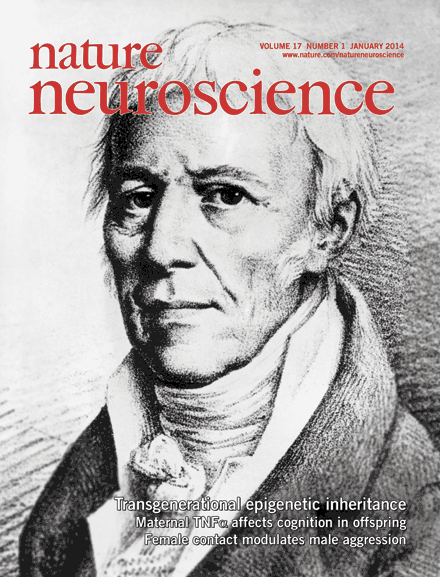
A revival for Jean Baptiste Lamarck?

Embedded image permalink 

Posted by Erik Svensson

The latest issue of the journal Nature Neuroscience has the famous French evolutionary biologist Jean Baptist Lamarck on its cover. This is of course quite an unusal cover for a journal which is rather mechanistically oriented, and the reason is probably an article by Brian K. Dias and Kerry J. Ressler entitled "Parental olfactory experience influences behaviour and neural structure in subsequent generations."  The claim made in this article, as well as implied by the choice of journal cover and in the "News & Views"-article by Moshe Shyf is that Lamarck's old but generally outdated theory of inheritance of aquired characters might be true after all, and the central dogma of molecular biology (that genes influence the phenotype but not vice versa) might be wrong.

Extraordinary claims requires extraordinary evidence, and I think it would be useful to critically discuss this paper at this semester's first lab-meeting, which will take place in "Argumentet" (2nd floor, Ecology Building) on January 14 at 10.30.

Undoubtedly, some rather pompous proponents of a so-called "Extended Evolutionary Synthesis" (EES) will probably welcome this study in their endless battle against the so disliked "Neodarwinian Synthesis", which I personally prefer to call "The Modern Synthesis" and so does population geneticist Jerry Coyne.  

These endless, but often futile calls for "paradigm shifts" and "scientific revolutions" have been heard for many years, but have never been very succesful and appears to me to be more ideologically motivated than grounded in scientific advancements based on new theory or experimental results. A particularly enthusiastic proponent of the ESS, Massimo Piggliucci, has, however, seemed to have given up empirical evolutionary biology and moved on to philosophy instead, perhaps because the anticipated "revolution" did not happen the way he anticipated that it would? 

In any case, Massimo probably enjoys philosophy more than biology (no empirical evidence needed that complicates things) and hopefully he has a lot to think about, given that he has three PhD-exams with him (in genetics, evolutionary biology and philosophy). As you can hear, I am sceptical.

You can hear that I largely agree with Jerry Coyne on the likelihood and validity of a forthcoming "scientific revolution", and I think those who call for this suffer from the so-called BIS - Big Idea Syndrome. Moreover, scientific revolutions do not happen because you want them. To quote Richard Lewontin, Jerry Coynes former PhD-advisor who states critically the following about scientific revolutions:


Articles to discuss at lab-meeting (click on links): 


    Dias & Ressler

    Szyf