Showing posts with label Modern Synthesis. Show all posts

Friday, March 14, 2014

Lab-meeting about phenotypic evolution, the ongoing synthesis and assortative mating


Posted by Erik Svensson

This coming lab-meeting (Tuesday March 18, 10.30), I wanted to discuss a recent general research overview and perspective by evolutionary biologist Stevan J Arnold. It is about the ongoing synthesis in evolutionary biology, but it takes a longer historical perspective. It is the "American Society of Naturalist's Adress", and it is published in the same journal. Hopefully, you will get some feeling for where evolutionary quantitative genetics is today, where it has evolved from, and where it will go in the future. Hopefully, you will also agree that this is still a very dynamic and exciting research approach that will continue to provide many new insights in the genomic and postgenomic era, as it is a synthetic approach that adresses questions that cannot and will never be answered by molecular approaches alone.

You will find the title, the abstract and a link to the article below. Related to this article, I will also spend a few minutes showing some simulation results of what disruptive selection gradients are useful for, and how they can be used to say something about the future.

Phenotypic Evolution: The Ongoing Synthesis


I explore the proposition that evolutionary biology is currently in the midst of its greatest period of synthesis. This period, which I call the Ongoing Synthesis, began in 1963 and continues at the present time. I use analysis of citations, conduct, and content to compare the Ongoing Synthesis to widely recognized periods of synthesis in the nineteenth and twentieth centuries. To compare content, I focus on phenotypic evolution and compare current efforts with George Gaylord Simpson’s struggle to understand evolution in deep geological time. The essence of current effort is captured by the question, What is the best model for phenotypic evolution? Although many investigators are actively engaged in answering this question, I single out two examples of my own collaborative work for emphasis here. These two studies share three important characteristics: diagnosis of evolutionary pattern using massive data sets, validation of model parameter values using compilations of estimates (e.g., heritability, stabilizing selection, distance to an intermediate optimum), and identification of evolutionary process using alternative models of stochastic evolution. Our primary findings (discovery of the blunderbuss pattern and the result that rare bursts of evolution carry lineages out of established adaptive zones) compare favorably with important insights from the Modern Synthesis.

Wednesday, January 8, 2014

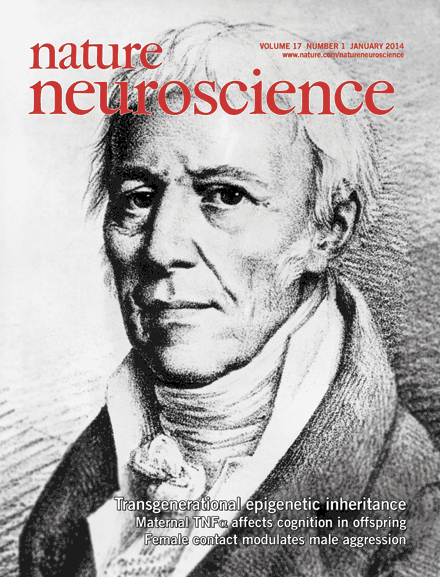
A revival for Jean Baptiste Lamarck?

Embedded image permalink 

Posted by Erik Svensson

The latest issue of the journal Nature Neuroscience has the famous French evolutionary biologist Jean Baptist Lamarck on its cover. This is of course quite an unusal cover for a journal which is rather mechanistically oriented, and the reason is probably an article by Brian K. Dias and Kerry J. Ressler entitled "Parental olfactory experience influences behaviour and neural structure in subsequent generations."  The claim made in this article, as well as implied by the choice of journal cover and in the "News & Views"-article by Moshe Shyf is that Lamarck's old but generally outdated theory of inheritance of aquired characters might be true after all, and the central dogma of molecular biology (that genes influence the phenotype but not vice versa) might be wrong.

Extraordinary claims requires extraordinary evidence, and I think it would be useful to critically discuss this paper at this semester's first lab-meeting, which will take place in "Argumentet" (2nd floor, Ecology Building) on January 14 at 10.30.

Undoubtedly, some rather pompous proponents of a so-called "Extended Evolutionary Synthesis" (EES) will probably welcome this study in their endless battle against the so disliked "Neodarwinian Synthesis", which I personally prefer to call "The Modern Synthesis" and so does population geneticist Jerry Coyne.  

These endless, but often futile calls for "paradigm shifts" and "scientific revolutions" have been heard for many years, but have never been very succesful and appears to me to be more ideologically motivated than grounded in scientific advancements based on new theory or experimental results. A particularly enthusiastic proponent of the ESS, Massimo Piggliucci, has, however, seemed to have given up empirical evolutionary biology and moved on to philosophy instead, perhaps because the anticipated "revolution" did not happen the way he anticipated that it would? 

In any case, Massimo probably enjoys philosophy more than biology (no empirical evidence needed that complicates things) and hopefully he has a lot to think about, given that he has three PhD-exams with him (in genetics, evolutionary biology and philosophy). As you can hear, I am sceptical.

You can hear that I largely agree with Jerry Coyne on the likelihood and validity of a forthcoming "scientific revolution", and I think those who call for this suffer from the so-called BIS - Big Idea Syndrome. Moreover, scientific revolutions do not happen because you want them. To quote Richard Lewontin, Jerry Coynes former PhD-advisor who states critically the following about scientific revolutions:


Articles to discuss at lab-meeting (click on links): 


    Dias & Ressler

    Szyf