Tuesday, December 30, 2014

Happy New EXEB year 2015!

Happy-New-Year-Copy

Posted by Erik Svensson

On behalf of myself and all EXEB members, I wish us all a Happy New 2015, and I hope it will be a succesful as 2014 was. Here, I briefly summarize my own subjective impressions of the past year and speculate a little bit about the future.

2014 was very dynamic and a lot of positive things happened. Maren Wellenreuther and Machteld Verzijden got new jobs and moved to Denmark and New Zeeland, respectively. Tobias Uller started his position in Lund on 50 %, while finishing his position in Oxford. Viktor Nilsson-Örtman and Katie Duryea both got postdoctoral scholarships, from The Swedish Research Council (VR) and The National Science Foundation (NSF) and thus joined EXEB. Beatriz Willink started as a PhD-position in August. Thus, both influx and outflux in terms of members, and currently Tobias is in the process of recruiting several postdocs, so I anticipate that the EXEB meetings will be enriched by new faces with interesting new backgrounds soon.

In terms of major research grants, it has also been a succesful year. Both Jessica and I got grants from the Crafoord Foundation this spring, and Tobias got a three-year grant from the Swedish Research Council in November. It is if course very satisfying to get these grants, given the stiff competition and small margins these days, as they also help us to do the research we really want to do.

Publication-wise, it has also been a good year, with articles appearing in many good journals. For me and Jessica, perhaps the highlight was our PNAS-article about sexual selection on Wing Interference Patterns (WIP:s) in Drosophila melanogaster, and all the media attention it got. Tobias and his co-workers made a splash in Nature in October this year with their provocative essay "Does evolutionary theory need a rethink?", which also resulted in a discussion on this blog.

What about 2015 and the future? I am optimistic in both the short- and the long-term. I feel that we have been able to build a creative space for us as PI:s and for our students and postdocs and that we have an excellent platform to strengthen evolutionary biology in Lund within our department. It is now almost five years since the Department of Biology in Lund was formed as a merger between two old departments: The Department of Ecology and the Department of Cell- and Organismal Biology (COB). Evolutionary biology has, for several complex and historical reasons, not had a very strong visible profile in Lund.

The reasons for this historical neglect of evolutionary biology in Lund are both structural and a result of strong  and very biased personal opinions by past and some current leaders of our department. For several reasons (I strongly disagree with these views, however), evolutionary biology has not been percceived as a "real" or independent research field in Lund. Worse, it has sometimes even been dismissed by some with the argument that "everybody does evolutionary biology" or even "we should leave evolutionary biology to Uppsala instead, it is they who have an Evolutionary Biology Centre (EBC)".

Needless to say, I think these views are both wrong and outdated, but their existence points to some of the problems that we have ahead of us if we want to strengthen the evolutionary biology profile in Lund. I feel that it is more or less futile to try to convince the leadership at the department as a whole that evolutionary biology should become of one of Lund's profile research areas, because conservatism tends to increase up along the career ladder.

Instead, we need to build from below, by setting a good example: by recruiting excellent postdocs and PhD-students (which we do already have), by getting grants and by publishing our research in excellent high-quality scientific journals. Then, and only then, can we influence the department at the higher level and force the leadership to admit that evolutionary biology is indeed an independent and interesting research field in itself that deserves some higher recognition than it currently has got. And to achieve this goal, we should try to keep EXEB what it is already: an intellectually very dynamic research environment where we regularly meet and discuss science and exchange idéas, co-supervise students and postdocs and share equipment, skills and knowledge.

We should of course always be aware of the competition with other groups - both from within the department and from outside - but also do not hesitate to collaborate with other groups, such as the Theoretical and Population Ecology Group or Molecular Ecology and Evolution Laboratory, when it can help us to achieve our long-term goals to influence the Biology Department and strengthen evolutionary biology in Lund. 

Thankyou all for a very nice 2014 and see you again in 2015!

Saturday, December 13, 2014

Next week I thought we should reflect on how "learning-like" processes in development shape, and is shaped by, the evolution of plasticity.

A very useful and interesting entry to this literature is the following review by Emilie Snell-Rood (Abstract below):

http://icb.oxfordjournals.org/content/52/1/31.full

We will meet as usual in Argumentet at 10.30 on Tuesday, Dec 16. I will bring fika but you don't need to worry because I won't bake it myself.

Selective Processes in Development: Implications for the Costs and Benefits of Phenotypic Plasticity


Emilie C. Snell-Rood

Abstract

Adaptive phenotypic plasticity, the ability of a genotype to develop a phenotype appropriate to the local environment, allows organisms to cope with environmental variation and has implications for predicting how organisms will respond to rapid, human-induced environmental change. This review focuses on the importance of developmental selection, broadly defined as a developmental process that involves the sampling of a range of phenotypes and feedback from the environment reinforcing high-performing phenotypes. I hypothesize that understanding the degree to which developmental selection underlies plasticity is key to predicting the costs, benefits, and consequences of plasticity. First, I review examples that illustrate that elements of developmental selection are common across the development of many different traits, from physiology and immunity to circulation and behavior. Second, I argue that developmental selection, relative to a fixed strategy or determinate (switch) mechanisms of plasticity, increases the probability that an individual will develop a phenotype best matched to the local environment. However, the exploration and environmental feedback associated with developmental selection is costly in terms of time, energy, and predation risk, resulting in major changes in life history such as increased duration of development and greater investment in individual offspring. Third, I discuss implications of developmental selection as a mechanism of plasticity, from predicting adaptive responses to novel environments to understanding conditions under which genetic assimilation may fuel diversification. Finally, I outline exciting areas of future research, in particular exploring costs of selective processes in the development of traits outside of behavior and modeling developmental selection and evolution in novel environments.

Friday, December 5, 2014


For next week's lab meeting we will discuss selection on body size into two groups: lizards and damselflies. 

John (me) and Katie will co-presented results from two survival-selection studies. I will give a presentation on 4 years of survival and sexual selection on damselflies, and Katie will present a manuscript for comments. The manuscript will probably be distributed through e-mail or on the facebook group.

Time and place as usual (Tuesday 10:30 in Argumentet, Ecology Building 2nd floor). 


Saturday, November 22, 2014

Guest post by Andrew Hendry: "Pitchfork Science: Guppies, Stickleback, and Darwin’s Finches"


The following post is an invited personal guest post by Andrew Hendry at McGill University, who kindly invited me to write a guest post on "Eco-Evo-Evo-Eco"/Erik Svensson

By Andrew Hendry

I study Trinidadian guppies, threespine stickleback, and Darwin’s finches, surely 3 of the top 10 canonical vertebrate evolutionary biology “model” systems. I thus fall at one extreme (or is it three extremes?) on the “pick a model system and use it to answer my question” versus “develop a brand new system all my own” continuum. Many students and postdocs find themselves facing their own decisions about where to position themselves along this continuum. Should they take the shortcut of working with an established system so they don’t have to work out the simple details and can get right to addressing the big general questions? Or should they forge their own path and become an expert in something brand new? It might seem, based on the above listing, that I consciously took the first approach but the reality is something quite different. In truth, I used a “follow your nose” coincidence-and-serendipity approach to study system choice. I here trace my own personal history in these research areas before closing with some general thoughts on how to choose a study system.

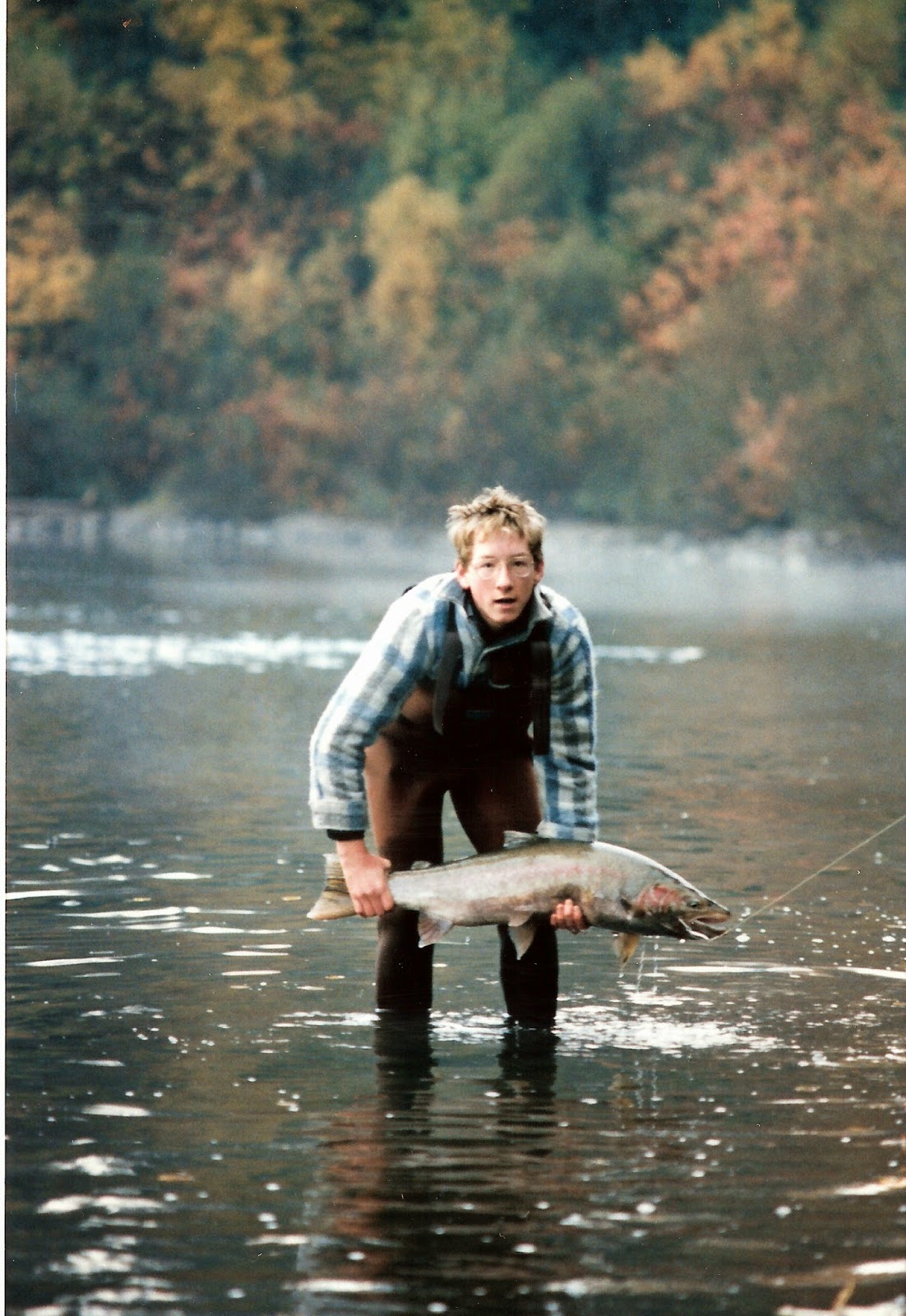
Why I study salmon - a 16 year old me with a steelhead from our cabin (Kispiox River, BC, Canada).
I worked on salmon for my MSc and PhD, largely because I grew up with salmon fishing as my primary passion. Thus, I began studying salmon simply because I liked them and liked fishing for them. This led me to choose an institution (University of Washington - UW), department (School of Fisheries), and supervisor (Tom Quinn) who were ideally suited to immerse myself in salmon work. As my graduate work progressed, I very gradually became more and more interested in general questions in ecology, largely through exposure to the research of other people in the department. I even started subscribing to Ecology in addition to – of course – Fisheries. Yet my thinking remained salmon-centric: “what can ecology tell me about salmon”. Nothing wrong with that, of course. Then, when visiting home for Christmas in 1994, I received from my mother a book: “The Beak of the Finch” by Jonathan Weiner. When your Mom gives you a book for Christmas and you then spend the next week at home… well, you better read it.

The laboratory for my PhD - Lake Nerka, Wood River, Alaska.
The book was amazing. It described in wonderfully readable prose the research of Peter and Rosemary Grant on Darwin’s finches in the Galapagos Islands. What struck me the most, while reading beside the heater vent looking out at the blowing snow and -40 C weather (literally!), was Jonathan’s description of how the Grants had documented generation-by-generation rapid evolution of finch beaks in response to natural selection resulting from environmental change. Wow – you can actually study evolution in real time! It was my own eureka moment and, in short order, I became captivated by the idea. As soon as I got back to UW after Christmas, I went to the library and photocopied EVERY paper on Darwin’s finches (ah, libraries and photocopying – the good [and bad] old days). From then on, almost as though my brain had achieved an alternative stable state, my thinking was inverted to become “What can salmon tell me about evolution.” 

My MSc and PhD work focused on sockeye salmon - this one in Knutson Bay, Lake Iliamna, Alaska.
Salmon did tell me a lot about evolution. I even edited a book (Evolution Illuminated, with one of my evolutionary idols, Steve Stearns) about merging evolutionary theory and salmon research. However, when one starts focusing on a topic (evolution) rather than an organism (salmon), one starts to become irked by aspects of the organisms that are not optimal for addressing the topic. Most notably, it is very hard to do experiments with salmon unless you have lots of water, lots of space, and lots of time. So, when thinking about a postdoc, I started talking to folks about which systems might allow me to better address basic evolutionary questions. I ended up moving in two directions.

The laboratory for my first postdoc. For more than a month of glorious weather, I camped on a small island in a small lake (Mackie Lake) at the end of a 4-wheel drive road. Those are my mesocosms floating in the lake and projecting from the island.
The first was the University of British Columbia (UBC) – because I didn’t want to go too far from my girlfriend (now wife) who was still at UW. I visited UBC and went from prof to prof telling them of my interest in a basic evolutionary question – the balance between divergent selection and gene flow – and asking if they knew of a system that would be good for testing my ideas. Many great suggestions were made, but Rick Taylor insisted he had the perfect system: Misty lake-stream stickleback – and he was right. So I started working on stickleback not because they were a model system, but because someone suggested they would be well-suited for my question and because it let me stay reasonably near my sweetheart.

A threespine stickleback guarding his nest.
The second direction came about through a conversation with Ian Fleming, who suggested that I should work with David Reznick on guppies. I hadn’t even considered this possibility, but I knew a bit about the system (it is also described in The Beak of the Finch) and it seemed cool. So I went to UCR and met with David and talked about how we might use guppies to study the interaction between selection and gene flow. David said he would be happy to help me with this work but that he didn’t have any money for me – and so I offered to write a full NSF proposal. I was just gearing up to do so when I heard that I had received an NSERC (Canada) postdoctoral fellowship to work with Rick Taylor on the Misty system – so off I went to stickleback, leaving guppies behind.

My favorite wild guppies captured in my first year of sampling, 2002.
UBC was great, an outstanding place for nurturing interest and insight into general questions in evolutionary biology, but one must eventually move on. My next postdoc was the Darwin Fellowship (I applied because of the title) at the University of Massachusetts (UMASS) Amherst, working with BenLetcher on salmon again (hard to shake the habitat). While at UMASS, my guilt started building about telling David I would write an NSF grant and then not having done so, so I went ahead and wrote one, which got funded on the second shot (after bringing in my salmony lab-mate from Tom’s lab, Mike Kinnison). So my work on guppies eventually developed owing to guilt about not carrying through on something I said I would do.

The laboratory for our guppy work - here the Paria River, Trinidad
While at UMASS, my office happened to be near that of JeffPodos, who was working on Darwin’s finches. Near the end of my Darwin Fellowship, Jeff received an NSF Career grant and had money to burn – I mean invest. Jeff knew of my interests and asked if I wanted to come along to the Galapagos on the project (he recalls me asking – or perhaps begging – to come with him), and of course I immediately said yes. So my work on finches was simply a case of being in the right place at the right time. It was every bit as exciting as promised that cold winter back in 1994. Several years later, Jonathan Weiner called to talk about my salmon work and I was able to tell him how influential his book had been and how it actually brought me (without any plan) to work on finches.
In short, a large amount of coincidence and serendipity determined my choice of study systems. Once in each of the three systems, I became enamored with them and never left. I have now 25 papers on stickleback, 22 papers on guppies, and 11 papers on finches, and I have no intention of ever pulling back from any of these systems. I have also published 33 papers on salmon, and I continually look for new opportunities for additional work on them.

The laboratory for our finch work, presided over by a marine iguana.
Peter Grant once told me that, in conversation with Daniel Pauly at UBC, Dan told him that he (Peter) was a “point person” whereas he (Daniel) was a “line person”: a point person being someone who takes a single subject/system (finches) and looks at every aspect of their ecology and evolution, and a line person being some who takes a single subject (fisheries) and looks at it across many systems. I guess that makes me a pitch-fork person – trying to go into depth in three systems. Of course, this means that I can’t get too deep in any one system, much to my frustration. However, comparing and contrasting results from the three systems has proven fascinating. For instance, I study ecological speciation in all three systems with essentially the same methods (catching, banding/marking, measuring, recapturing, genotyping) focused on revealing the same processes (disruptive/divergent selection, adaptive divergence, assortative mating, gene flow). The similarities and differences in results obtained from the three systems has proved very instructive and motivational. In fact, my favorite research talk involves walking through a comparative story of ecological speciation in the three systems.

Perhaps my favorite finch photo.
Beyond how many systems one works in, I need to return to the question of working with model (developed) versus new (undeveloped) systems. As noted earlier, a benefit of working in a model system is that one doesn’t have to do as much background work (although every system is nowhere near as well-understood as the impression given by the literature), whereas a cost is that you are never known as the expert in that system (because the experts are the senior folks working on the same thing). The cost-benefit payoff is not easy to calculate and so the temptation for many students and postdocs is to spend a lot of time debating the pros and cons of the different approaches. I think all this angst is a mistake (or at least suboptimal) and that one should instead follow one’s nose (and Mom’s book recommendations). I think everyone should work on the systems and with the people that they find the most interesting and inspiring – not the systems that have the best-described genomes (as an example). These inspiring systems might be model systems or they might be new systems or both (I also have students work on non-model systems), but they are – most importantly – the systems that feel right at the time, not the systems that have been rationalized based on a logical calculation of optimal career advancement. It worked out fine for me (and many others) – although I am sure my colleagues would argue I could still use considerably more career advancement.

-----------------------------------------

Resources:

An interesting perspective by Joe Travis on question-based versus system-based science: Is it what we know or who we know? Choice of organism and robustness of inference in ecology and evolutionary biology

Friday, November 21, 2014

Lab meeting Nov 25th: Two talks!

Posted by Anna Nordén and Anais Rivas Torres

Next lab meeting Anais and I will give one talk each. Anais will present some of her results from her MSc thesis and I will show some preliminary results and how that is connected to my PhD project. I am going to give the talk at a worm meeting later next week. We would be happy to get any comments on results and tips on how to improve the presentation! Below are two short abstracts summarizing what we will talk about.

Time and place as usual (Tuesday 10:30 in Argumentet, Ecology Building 2nd floor).

Looking forward to see many of you there!

Anais: Neutrality or coexistence through negative frequency dependence?

Through my research I want to investigate why two related species (Calopteryx splendens and Calopteryx virgo) could coexist, although they have similar niches.
Nowadays, one cannot a priori assume that each and every species found together in a local community need to coexist in the long run. Instead, local community composition might follow a neutral community dynamics. However, ecologically equivalent species cannot coexist infinitely, so there needs to exist some coexistence mechanism(-s) if two or more species are going to continue to coexist locally. The aim of my Master thesis will be to experimentally investigate and search for potential co-existence mechanisms between two ecologically similar damselfly species within the same genus(C. virgo and C. splendens). In particular, I will investigate the possibility of co- existence through negative frequency dependence mechanisms, i.e. that a species does better when it is rare than when it is common.


 Anna: Experimental evolution in Macrostomum lignano

Photo by Micha Eichmann, Schärer Group
Sexual antagonism occurs when the same allele for a gene has opposite fitness effects for females and males. Although generally studied in sexual organisms, sexual antagonism may occur in hermaphrodites and may be one means by which genetic variation is maintained. To investigate this, we measure the response to sex-limited evolution in populations of the flatworm Macrostomum lignano to determine if a hermaphrodite can evolve sex-differentiated chromosomes. A GFP (green fluorescent protein) locus incorporated into the worm’s DNA is used as a dominant sex-determining gene by letting it pass through either eggs (‘female’ treatment) or sperm (‘male’ treatment) in each generation. After many generations, this creates an accumulation of standing genetic variation of sex-specific fitness genes linked to the GFP locus. Additionally, we use quantitative genetics to measure sexually antagonistic genetic variation for fitness in M. lignano. This allows us to look at the heritability of fitness via male and female sex roles, and the amount of genetic diversity that results from our sex-limited evolution experiment. Here, we present preliminary data on the heritability of the GFP marker through male and female sex roles.

Sunday, November 16, 2014

What happens when eight researchers suggest there is value in multiple, alternative conceptual frameworks in evolutionary biology?

Posted by Tobias Uller

A few weeks ago EXEB discussed a commentary about the structure of evolutionary theory that I was a co-author on. I listened to the discussion and a lot of insightful things were said. Unfortunately, Erik was not able to attend but he has now shared his perspective online instead; all in friendly disagreement. Erik’s comments are quite similar to several other reactions we have had so I will highlight a few things that I think are worth noting. But if you are interested in my opinion it is no doubt more informative to simply come and discuss with me in person.

What did we publish?

The paper was an invited popular science commentary in a magazine called Nature. The editors of Nature knew we were writing a detailed academic paper (10,000 words, 250 references, currently in review). This paper attempts to explain how some critiques of contemporary evolutionary biology are conceptually aligned. Nature asked us to write a popular summary arguing that these perspectives may stimulate a rethink of certain aspects of evolutionary theory. Another team were asked to argue against this notion.

Our instructions were to write for a general audience and make it understandable and appealing to – as roughly stated by the editor - astronomers and others with a limited knowledge of evolutionary biology. We think it worked reasonably well overall, but the rhetoric on both sides naturally reflects Nature’s aim with the commentary and hence should be taken lightly. We did not know the author list of the other team (and only saw their response as it was published), but I assume they had similar instructions.

Erik thinks that this type of popular science should not be published in scientific magazines but instead posted on blogs. I do not read blogs much, but they are a good source of information about what people like about themselves and dislikes about others. Sometimes posts also help to interpret and understand science (e.g., Arild Stoltzfus' comment here). Similarly, glossy science magazines can be entertaining and informative and the many private and public responses to our commentary show that Nature indeed has a large and diverse readership. 

The main aim with this Yes/No piece was to encourage debate across disciplines about what counts as evolutionarily relevant causes and processes. This appears to have worked. So I think it is ok for Nature to publish these more informal pieces if they want. After all, magazines do not have the same aims as specialist academic journals, which may be good to remember also when we read scientific articles that are published in Nature.

Rethinking what?

Rethinking theory can mean a number of different things. Interpretation varies somewhat even among the authors of the ‘Yes’ comment. But many evolutionary biologists seem to think that as long as variation, heredity, and differential reproductive success remain central to evolutionary theory there is no such thing as a rethink.

I find this a pretty drab view of our field since it implies that we are only adding footnotes to the Origin of Species.  Indeed, this is pretty much the impression one gets from the ‘No’ comment – although their extensive Darwin references are likely there for rhetoric and journalistic effect and not because the authors think that evolutionary theory lacks progress.

Thinking about the structure and content of theory is healthy and something that all scientists should do regularly even if core aspects of our theories remain the same. The ‘Yes’ authors think that there are some important features of contemporary evolutionary biology that are problematic, including the proximate/ultimate distinction, the separation of heredity and development, and neglect of attention to the developmental origin of innovations. 

If we are to change this situation we need to rethink. But we have never claimed that this should be described in terms of revolution or a paradigm shift. Indeed, it is unlikely that fundamental insights from what we call standard evolutionary theory will be proven false. We think we can understand things even better. That is why we advocate an expansion of what counts as relevant causes of evolution – by shifting our perspective we can see things clearer.

We too have our reservations about the use of the term Extended Evolutionary Synthesis, which undoubtedly comes with some unwanted baggage. Nevertheless, naming a putative conceptual framework as it is being formulated can help to see how it differs from others. But it should not be interpreted as meaning something more than an attempt to provide a coherent perspective that differs from the prevailing view (as opposed to add-ons as the ‘No’ side and Erik appear to view things).

At the end of the day, the usefulness of a conceptual framework is measured by the extent to which it stimulates useful research. I, and my co-authors, fully agree with Erik that we need much more empirical work. But we also need ideas to guide us. We said: “We believe that a plurality of perspectives in science encourages development of alternative hypotheses, and stimulates empirical work”. 

In contrast, the ‘No’ authors appear to reverse the order and ask that empirical support precedes consideration of alternative perspectives (last page of their comment).  Because one of our main points is that conceptual frameworks channel thinking – and hence affect not only our interpretation of data but also what data we collect – this appears to be a major difference in philosophy of science between the two sides.

History Lessons and the Straw Man

Nevertheless, Erik is surely right that evolutionary biologists have not prevented him from studying how learning shapes mate choice. But on a more positive note, he also appears to have been inspired to do so by people like Mary-Jane West-Eberhard, who have argued that plasticity plays important roles in evolution. 

This theory may seem uncontroversial to some today, with the leading journal in organismal evolution recently publishing a review on the topic (which clearly shows we need more explicit empirical testing). But the idea certainly represents a, possibly incomplete, rethinking of evolutionary theory that was not very welcomed when it arrived, and is still poorly understood. If you have forgotten the discussions in coffee rooms following publication of Developmental Plasticity and Evolution, or if you have entered science more recently, it may be useful to read how the Nature reviewers of the book reacted to these ideas when they were published in 2003. Would we have vibrant work on plasticity and evolution without West-Eberhard's and others’ outspoken efforts to outline alternative conceptualizations of how evolution works?

The straw man is a helpful fellow. In a single stroke he lets you dismiss someone’s argument simply by inferring that that you understand the topic better. What is frustrating for both the ‘Yes’ and ‘No’ authors is that straw-man advocates imply that a 1700 word popular commentary written for a general audience is all that either side has to back up their points. How else could one know that these are straw man arguments?

Given that there are some quite intelligent, experienced, and well-respected researchers in both camps, assuming they got it wrong because of major gaps in their knowledge of evolutionary theory strikes me as somewhat arrogant. Admittedly, the Nature commentary is not overly helpful for evolutionary biologists, who would of course like to see the arguments fully fleshed out (as, of course, would we).

But the details of how our examples are unified conceptually, and how this differs from standard evolutionary theory, were deemed too complicated for the average reader of Nature (remember that this is not an evolutionary biology journal and that the comment was written with a very different audience in mind). Similarly, the ‘No’ response does not attempt to explain why no conceptual change is needed, presumably for the same reasons. 

This is no doubt frustrating for us all, but hardly a reason to conclude that there is no substance to the claims of either side. To avoid this situation Kevin Laland asked the ‘No’ authors if we should provide a more informative joint analysis elsewhere, but they declined.

Erik’s diagnosis is that if we would properly understand adaptive landscapes we would not have been misled to believe that new insights flow from the research fields we highlight in our commentary. It is true that the adaptive landscape is helpful for thinking about, for example, the evolutionary implications of plasticity (see e.g., Frank 2011,who also includes a personal reflection on why he was slow to appreciate the idea). We have never claimed anything else. In fact, I use this approach in my lectures on plasticity and evolution for third-year Oxford undergraduates. 

The Arnold paper Erik refers to is interesting and I encourage people to read it alongside our own contribution when it eventually becomes available. There are substantial differences in aims, approaches, and conclusions – it will be useful to examine these if you want to make up your mind on what questions are urgent to answer in evolutionary biology (through models, experiments, comparative tests and so on). I find that I learn more from people with alternative views, even if I disagree with what they say.

Evolution is a simple idea but actually quite difficult to understand in any detail. Trying to formulate an alternative perspective is, in my opinion, the best way to see if we are missing something. If you want pointers to the large literature that can provide useful insights into what this 'something' may be please do not hesitate to ask. 


Wednesday, November 12, 2014

Lab meeting: Running with the Red Queen

Posted by Katie Duryea

Following our discussions in lab meeting this week, I propose we devote next week's lab meeting to discussing a recent paper by Brockhurst et al. on the Red Queen hypothesis.

The Red Queen hypothesis was first proposed by Van Valen in 1973 to describe how interactions among species can often be a rapid driving force in evolution. This is because evolutionary change in one species may be matched by coevolutionary change in another species. Or, to make the analogy with Lewis Carroll's Red Queen, a species must be continually adapting just to keep pace with its enemies.

"Now, here, you see, it takes all the running you can do, to keep in the same place. If you want to get somewhere else, you must run at least twice as fast as that!" -Lewis Carroll, 1871

Since it was first proposed by Van Valen over 40 years ago, the Red Queen process has been applied to a number of inter and intraspecific conflicts (including intragenomic conflict and sexual conflict). In their recent paper, Brockhurst et al. develop a framework for distinguishing three modes of Red Queen dynamics based on the mode of selection (fluctuating or directional) and the genetic architecture of the traits under selection. Does this framework help us to better understand evolutionary conflicts? Let's discuss! 

When: Tuesday, November 18, 10:30
Where: Argumentet, 2nd floor, Ecology building

Running with the Red Queen: The Role of biotic conflicts in evolution

Abstract

What are the Causes of Natural Selection? Over 40 years ago, Van Valen to proposed the Red Queen hypothesis, Which emphasized the primacy of conflict biotic over abiotic forces in driving selection. Species must continually evolve to survive in the face of evolving Their enemies, yet on average Their fitness remains Unchanged. We define three modes of the Red Queen Coevolution to unify bothering fluctuating and directional selection within the Red Queen framework. Empirical Evidence from natural interspecific antagonisms Provides support for each of These modes of Coevolution and Suggests That They thwart operate Simultaneously. We argue That understanding the evolutionary forces Associated with interspecific interactions requires incorporation of a community framework, in Which new interactions Occur frequently. During Their early Phases, These newly Established interactions are likely to drive the evolution of Both parties. We argue Further That a more complete synthesis of the Red Queen forces requires incorporation of the evolutionary conflicts within species That Arise from sexual reproduction. Reciprocally, taking the Red Queen's perspective advances our understanding of the evolution of These intraspecific conflicts.