Monday, October 7, 2013

The Progressive Loss of Syntactical Structure in Bird Song along an Island Colonization Chain

Posted by Machteld

A long, long, time ago, in a land not that far away from here, I worked on birds. Bird song, to be exact; learned bird song, to be even more exact. Why do songbirds sing the way they do? Why is it so consistent in some species, and why do other species have dialects?

It may be more easy to understand how geographical variation occurs in learned birdsong, than to understand the absence of it. Mistakes can occur in the learning process (cultural mutations), the transmission of the sound is different in some places putting natural selection on the song frequencies, and perhaps other species interfere with the vocal communication. These are all good reasons why the song of a species might differ between places.  However, most songbird species – all of which learn their song, show a high consistency of species specific song.  How do they do that?

Although the particular notes in songs differ between songs, one individual may even have several songs, and between males within a species there will be variation; there is a certain overall structure, which makes a great tit song recognizable from a blue tit’s song or a chaffinch’s song. This is called the ‘syntax’ of bird song, where each note is a ‘syllable’ in the analogy with human speech.
One explanation for how birds maintain their species’ typical song, even if the particular notes (syllables) in the song differ over time and distance is that birds have a filter, or bias, for what kind of song they learn. If you think about it, this makes some sense, since young birds learning their song will hear lots of sounds and bird song from other species. A pre-set bias will give them some guidelines of which songs to learn.  

But clearly, there is variation between species in syntax, so how did this evolve? One would think that, after so many years of biologists studying bird song (and they’ve been at it for decades – ever since the Bell Telephone Laboratories made it possible to make sounds visible on paper in the 40’s) there would have been some good handle on this issue. Not so, unfortunately. One particular technical problem that has bothered progress is that syntax is hard to quantify. There have been attempts, but this always ended in semantic debates about definitions, and well, very little progress is made when that happens.
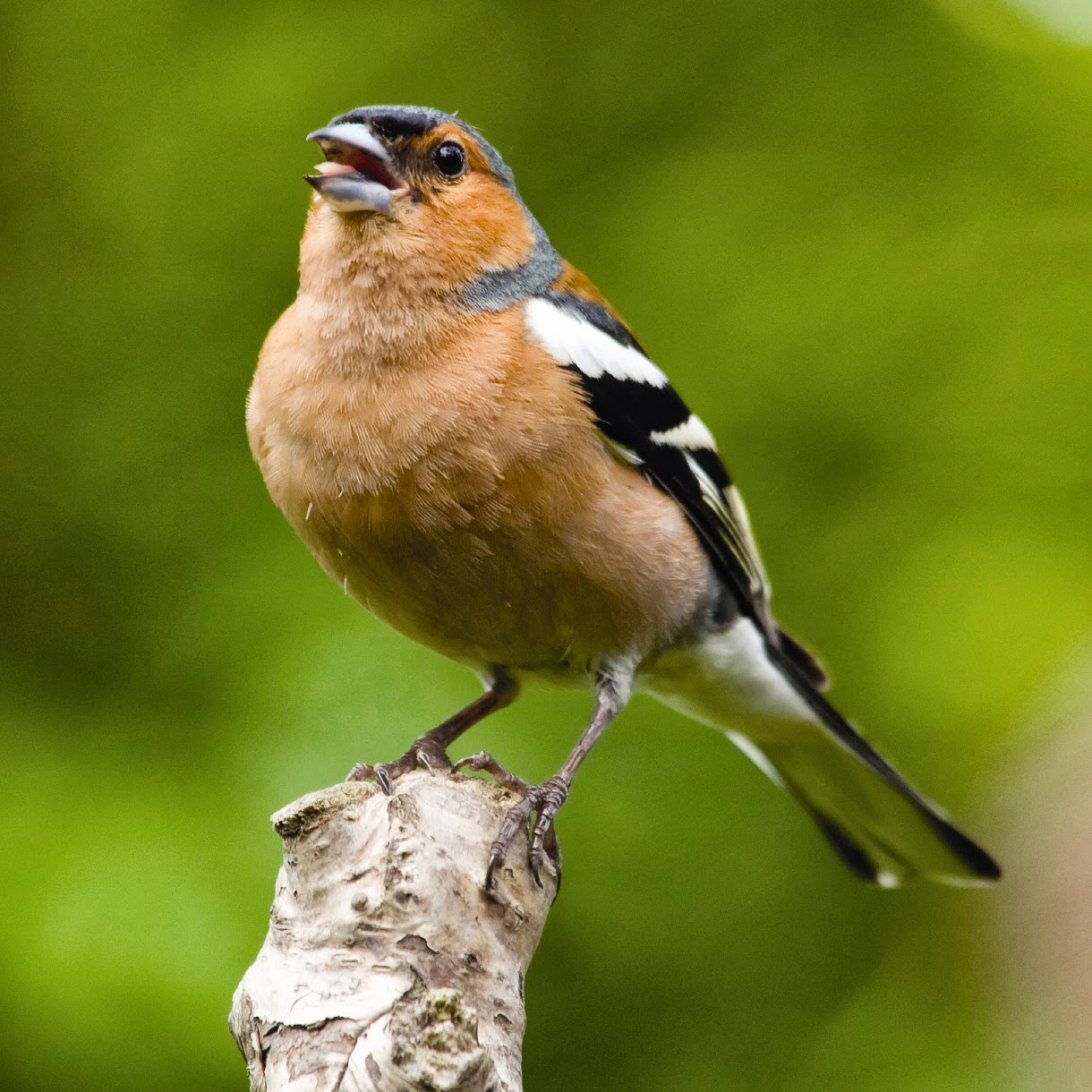
A chaffinch male, picture taken from feedyourbires.co.uk
Well, there is where this paper comes in. This is a study on the song of chaffinches. A bird that has been the focus of bird song studies ever since the beginning (1954).  This is a very common bird throughout Europe (and also in other parts of the world, having been deliberately exported on a few occasions), and lives on the mainland of Europe, but also on almost all of the islands in the periphery of the continent in the Atlantic, such as Britain, the Azores, the Canary islands). The nice thing is that the colonization route of the chaffinch to those islands had been figured out already quite a while ago, so that we had a repeated evolutionary experiment at our hands, not unlike the finches at the Galapagos. They first colonized the Azores, then went on to the Canary Islands, with Gran Canaria the last island to get colonized by the finches. 

Many, many, many, many, recordings of chaffinches later, on all those wonderful locations (which I was lucky to be part of on some of those locations, such as the little gem of an island El Hierro), we created a database of chaffinch song in Europe.

That was the practical part. Then the hard statistics came in. I am not going to try to explain this here in detail, but in essence, per population, the songs were analyzed to see which were the ‘atoms’, or the parts that always occurred as a unit, such as a syllable (song note) or group of syllables. Then, zoom out, and repeat this process: which units (classes of syllables) always occur together. You can see how you can start to quantify things this way. The more you can cluster units within units within units, the higher the redundancy in the syntax of a song, i.e. the more stereotypical a song is.
Mainland Europe chaffinch song is highly stereotypical. Songs sung by birds in Holland and Spain follow very much the same syntax. This starts to differ once you get on to the islands, first the Azores, then the Canary Islands, where this structure starts to fall apart, until at the last island, Gran Canaria, there is almost no syntactical structure to be found. Clearly, with every colonization event, syntactical structure in the song disappeared a little.

Why did this happen? There are a few possible explanations, and read the paper for those, but one thing that we argue is that populations that go through bottle necks, such as at each colonization event, there is strong selection to recognize anything that might possibly be a conspecific. The learning biases that I mentioned in the beginning were thus selected to become less restrictive, i.e. less biased. A wider range of songs passed for species’ specific song. If this happens a enough times, you end up with no structure in your song. Which is what you find in Gran Canaria. 

And now this work has resulted in a wonderful publication, in Current Biology, available online, but in press still: 


Friday, October 4, 2013

Non-genetic inheritance

Posted by: Machteld


Next week's lab meeting will be about non-genetic inheritance, since this is the topic of a workshop I will be attending (as will Jessica) this December. This is a good moment to start reading up on it, and since this is a broadly written paper on the topic, this might be a great introduction to all of you as well, so you might have some idea what Jessica and I will be working on during that workshop :).

Since it is published in an open access journal, I've linked the paper here, for everyone's convenience.

Non-genetic Inheritance in Evolutionary Theory: a Primer

By Tobias Uller and Heikki Helanterä

Abstract: 
Evolutionary biology traditionally equates inheritance with transmission of genes from parents to offspring. However, recent literature calls for considering ‘non-genetic inheritance’ in evolutionary theory. These calls have met with substantial scepticism. What is more, they appear to have caused further confusion both with respect to what inheritance is and what types of inheritance mechanisms are evolutionarily consequential. Building on previous work, we make use of the Price Equation to outline a general discussion of how non-genetic inheritance can affect phenotypic change within populations, exemplified by epigenetic inheritance. This shows that integrating non-genetic inheritance in evolutionary theory will require specific attention to the developmental processes that shape the relationship between the fitness of parents and the phenotype of their offspring.

See you all on Tuesday!

Thursday, September 26, 2013

Next lab meeting: genetics of ageing

Posted by Jessica Abbott on behalf of Qinyang Li
One of Qinyang's lovely fly pictures.

For next week's lab meeting, I suggest we can talk about this study on sexual dimorphism of life span in Drosophila. It's an interesting topic to me and also relevant to our fly works.

Title: Heritability of Life Span Is Largely Sex Limited in Drosophila

Abstract: Males and females differ with respect to life span and rate of aging in most animal species. Such sexual dimorphism can be associated with a complex genetic architecture, where only part of the genetic variation is shared between the sexes. However, the extent to which this is true for life span and aging is not known, because studies of life span have given contradictory results and aging has not been studied from this perspective. Here we investigate the additive genetic architecture of life span and aging in Drosophila melanogaster. We find substantial amounts of additive genetic variation for both traits, with more than three-quarters of this variation available for sex-specific evolutionary change. This result shows that the sexes have a profoundly different additive genetic basis for these traits, which has several implications. First, it translates into an, on average, three-times-higher heritability of life span within, compared to between, the sexes. Second, it implies that the sexes are relatively free to evolve with respect to these traits. And third, as life span and aging are traits that integrate over all genetic factors that contribute to mortal disease, it also implies that the genetics of heritable disease differs vastly between the sexes.

 N.B.!  As per our discussion last week, everyone should prepare two short contributions about the paper to share with the group.  These need not be anything very extensive - questions about the content, short observations about your thoughts on the paper (e.g. interesting or not, and why), if there was something you thought was unclear, etc.  All these things are fine.

Thursday, September 19, 2013

Burying beetles: Older males 'make better dads'


Posted by Jessica Abbott on behalf of Katrine Lund Hansen 


Next week we’ll discuss how age affects parental care in the burying beetle Nicrophorus vespilloides.


Paper: http://www.ncbi.nlm.nih.gov/pmc/articles/PMC3712429/

Abstract: Theory predicts that male response to reduced paternity will depend on male state and interactions between the sexes. If there is little chance of reproducing again, then males should invest heavily in current offspring, regardless of their share in paternity. We tested this by manipulating male age and paternity assurance in the burying beetle Nicrophorus vespilloides. We found older males invested more in both mating effort and parental effort than younger males. Furthermore, male age, a component of male state, mediated male response to perceived paternity. Older males provided more prenatal care, whereas younger males provided less prenatal care, when perceived paternity was low. Adjustments in male care, however, did not influence selection acting indirectly on parents, through offspring performance. This is because females adjusted their care in response to the age of their partner, providing less care when paired with older males than younger males. As a result offspring, performance did not differ between treatments. Our study shows, for the first time, that a male state variable is an important modifier of paternity–parental care trade-offs and highlights the importance of social interactions between males and females during care in determining male response to perceived paternity.

Tuesday September 24th, 10:30 in Argumentet as usual and I will provide some fika.
Hope to see you there!

Thursday, September 12, 2013

How does penis size influence male attractiveness in humans?

Posted by Anna Nordén


Next week we'll discuss how penis size together with height and body shape influence male attractiveness in humans. One of the authors, Brian Mautz, actually presented the results from this study at the ESEB congress in August this year and it generated a lot of interesting questions and discussion, which I hope we will have as well.

Paper: Penis size interacts with body shape and height to influence male attractiveness

Abstract: Compelling evidence from many animal taxa indicates that male genitalia are often under postcopulatory sexual selection for characteristics that increase a male’s relative fertilization success. There could, however, also be direct precopulatory female mate choice based on male genital traits. Before clothing, the nonretractable human penis would have been conspicuous to potential mates. This observation has generated suggestions that human penis size partly evolved because of female choice. Here we show, based upon female assessment of digitally projected life-size, computer-generated images, that penis size interacts with body shape and height to determine male sexual attractiveness. Positive linear selection was detected for penis size, but the marginal increase in attractiveness eventually declined with greater penis size (i.e., quadratic selection). Penis size had a stronger effect on attractiveness in taller men than in shorter men. There was a similar increase in the positive effect of penis size on attractiveness with a more masculine body shape (i.e., greater shoulder-to-hip ratio). Surprisingly, larger penis size and greater height had almost equivalent positive effects on male attractiveness. Our results support the hypothesis that female mate choice could have driven the evolution of larger penises in humans. More broadly, our results show that precopulatory sexual selection can play a role in the evolution of genital traits.

Tuesday September 17th, 10:30 in Argumentet as usual and I will provide some fika. 
Hope to see you there!

Saturday, September 7, 2013

Macroevolutionary speciation rates are decoupled from the evolution of intrinsic reproductive isolation in Drosophila and birds

Paper for next week's meeting!

Abstract

The rate at which speciation occurs varies greatly among different kinds of organisms and is frequently assumed to result from species- or clade-specific factors that influence the rate at which populations acquire reproductive isolation. This premise leads to a fundamental prediction that has never been tested: Organisms that quickly evolve prezygotic or postzygotic reproductive isolation should have faster rates of speciation than organisms that slowly acquire reproductive isolation. We combined phylogenetic estimates of speciation rates from Drosophila and birds with a method for analyzing interspecific hybridization data to test whether the rate at which individual lineages evolve reproductive isolation predicts their macroevolutionary rate of species formation. We find that some lineages evolve reproductive isolation much more quickly than others, but this variation is decoupled from rates of speciation as measured on phylogenetic trees. For the clades examined here, reproductive isolation—especially intrinsic, postzygotic isolation—does not seem to be the rate-limiting control on macroevolutionary diversification dynamics. These results suggest that factors associated with intrinsic reproductive isolation may have less to do with the tremendous variation in species diversity across the evolutionary tree of life than is generally assumed.

link to paper

10.30 Tues in Darwin
fika will be provided!

Thursday, August 29, 2013

Next lab meeting: something for everyone


Posted by Jessica Abbott

Female Drosophila melanogaster, photo by Qinyang Li.


Next week we'll have the first paper discussion of the fall.  I've chosen a paper that hopefully will have something for everyone, as it covers a number of different topics: biogeography, reproductive isolation, sex chromosome evolution, and fruit flies.

The paper: Tropics accelerate the evolution of hybrid male sterility in Drosophila

Abstract: Understanding the evolutionary mechanisms that facilitate speciation and explain global patterns of species diversity has remained a challenge for decades. The most general pattern of species biodiversity is the latitudinal gradient, whereby species richness increases toward the tropics. Although such a global pattern probably has a multitude of causes, recent attention has focused on the hypothesis that speciation and the evolution of reproductive isolation occur faster in the tropics. Here, I tested this prediction using a dataset on premating and postzygotic isolation between recently diverged Drosophila species. Results showed that while the evolution of premating isolation was not greater between tropical Drosophila relative to nontropical species, postzygotic isolation evolved faster in the tropics. In particular, hybrid male sterility was much greater among tropical Drosophila compared to nontropical species pairs of similar genetic age. Several testable explanations for the novel pattern are discussed, including greater role for sterility-inducing bacterial endosymbionts in the tropics and more intense sperm–sperm competition or sperm–egg sexual conflict in the tropics. The results imply that processes of speciation in the tropics may evolve at different rates or may even be somewhat different from those at higher latitudes.

Same time and place as usual, Tuesday the 3rd of September at 10:30 in Argumentet.